
tExtended created a strong basis for textile circulation
Written by: Satu-Marja Mäkelä, Pirjo Heikkilä and Julia Vuorinen from VTT Technical Research Centre of Finland
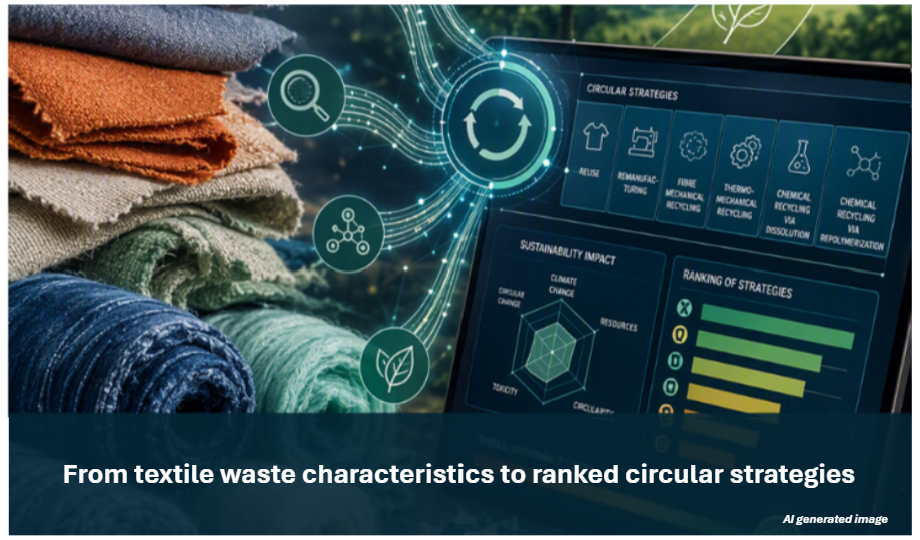
The tExtended project has achieved an important milestone (MS8) by updating the theoretical basis for extended textile recycling with lessons from its Real Scale Demonstrator. The achievement is verified through updated versions of the textile classification system and the Textendifier tool, which together support informed routing of discarded textiles towards reuse, remanufacturing and recycling. In practice, the work has transformed an expert-based theoretical model, Conceptual Framework, into a practical Textendifier tool that has been tested and refined using real material flows, processing chains and operational conditions.
From theory to practical decision support
The theoretical basis combines information on textile composition and quality, potential applications, technical feasibility, and economic, environmental, and circularity impacts of recycling technologies. The classification system characterises the materials, while the Textendifier tool identifies feasible reuse and recycling routes and optimises their impacts to maximize value retention and sustainability. Trade-offs between impacts (e.g. cost vs. environmental benefit) are unavoidable, so the tool applies a systematic optimisation approach to take the different impacts into consideration.
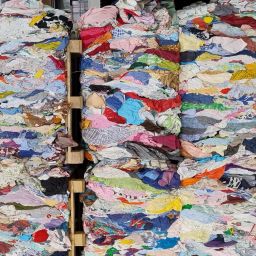
The Real Scale Demonstrator tested these principles with urban and industrial textile streams. Materials were collected, identified, sorted and processed through reuse, remanufacturing, fibre mechanical, thermo-mechanical and chemical recycling routes, leading to new textile materials and products.
What determines a feasible route
The demonstrator confirmed that routing cannot be based on fibre composition alone. Material condition, contamination, colour, construction, volume, output-quality requirements, logistics, infrastructure and compatibility between process steps all influence feasibility.
It also showed that textile recycling is an interdependent chain: sorting determines feedstock reliability, pre-processing determines process suitability, and recovered-material properties determine realistic applications. Traceability and sufficient industrial-scale volumes are therefore essential.
Constraints in material availability, quality, equipment and process scale provided valuable evidence about which routes are not only technically possible but operationally robust.
Classification for practical routing
Practical experiences refined the classification of textile waste for operational use in the Textendifier tool. It clarified the material characteristics and route-specific acceptance criteria needed to distinguish between reuse, remanufacturing and recycling options.
While recyclers would benefit from more detailed classification, many of the data points needed for thorough determination of material are currently not available, nor obtainable without destructive characterization. Therefore, classification built for Textendifier tool is a simplified model, which consist of data point mostly possible to determine by visual observation, allowing to use the tool also in existing sorting facilities.
This updated classification now provides structured input of achievable data for routing calculations and improves consistency when feedstocks are matched with recycling technologies and end-applications.
Textendifier tool refined through testing
Through validation activities carried out by the tExtended consortium and specifically its industrial partners using real materials, operational processes, logistics chains, and end-use outputs, the Textendifier tool’s route definitions, material requirements, usability, and supporting knowledge base were further refined. The validation activities provided valuable feedback on the feasibility, practicality, and effectiveness of the tool, enabling continuous improvement of the tool and its underlying knowledge base.
The resulting adaptable decision-support method follows the waste hierarchy, links material classification with route feasibility and sustainability considerations, and can evolve as technologies, data, and regional value chains develop. Together with the demonstrator and related project results, it provides a practical basis for safe, sustainable, and value-retaining textile circulation.
A foundation for implementation
By updating the theoretical basis with demonstrator evidence, tExtended connected research, tool development, and implementation. Real material flows and collaboration across the textile value chain were used to test and improve the routing principles.
The updated tool supports textile actors, regional developers, policymakers, and future research by clarifying material requirements, data needs, infrastructure gaps and route-specific trade-offs. Primary focus is to lower the entry barrier for those that want to enter the circular economy of textiles. It also provides a basis for further development and regional application of the Textendifier tool. The tool logic and model in the background have been designed and built in such a way that the tool can be easily adjusted for specific company or stakeholder use.
tExtended has therefore achieved the milestone by creating a tested and adaptable basis for selecting among multiple textile circulation pathways. The Real Scale Demonstrator converted operational experience into structured knowledge which was used to update both the classification system and the Textendifier tool.