

tExtended reaches another milestone: 80% waste reduction potential requires a systemic change
In June 2026, tExtended has reached its seventh milestone. As EU calls for waste reduction on all important sectors, the tExtended aims to show how 80% waste reduction could be achieved in the textile sector. To imitate the potential, tExtended has carried out a real scale demonstration, utilizing its/our partners’ network of recycling, reuse and remanufacturing operations. The evaluation of the different operations is done within the project.
Beyond the tExtended demonstrations, we have targeted the questions of how to achieve the reduction of waste through modelling simulations and defining the necessary actions after. The modelling provided nine scenarios reaching the 80% waste reduction target. Moderation of consumption, production and imports paved the way for the potential in all the scenarios, while other important interventions included product longevity, increased capacities, increased collection rates and lower loss in sorting. The simulation work was limited to assumptions and did not consider the necessary steps to reach the goals. To be able to say what really needs to happen, the different scenarios were then taken further to establish actions needed to realize the waste reduction. Three pathways towards waste reduction were defined: increase recycling and reuse, improve collection and sorting, and reduce consumption. The simulation results, the summaries of the pathways, and a view on how the waste flows will look like with 80% reduction are presented below.
Is 80% waste reduction possible – even theoretically?
Achieving the ambitious goal within the project is one thing and assessing the potential at a larger scale another. To assess the feasibility of an 80% system-wide reduction in waste, we developed a system dynamics model (Wiman et al. to be published 2026). The model represents a partially closed textile material loop for the textiles sector of the European Union. Our modelling approach was to define a set of 10 intervention strategies and combining them in different ways to find which strategies show most promise in improving the waste and circularity indicators. The most effective strategy for improving any given indicator is not obvious due to complex dynamics of the material loop and the uncertainty of multiple system parameters.
One of the key indicators in the model is under-utilized waste, which is defined as total textile incineration and textile waste export outside the EU, both representing environmental burdens and lost potential to circulate materials. In our simulation results, a particularly effective single strategy for reducing under-utilized waste was the moderation of total throughput. This strategy was also notably insensitive to system uncertainties, meaning that the high impact potential should apply even if our assumptions about the state were imprecise.
We simulated 33 pro-circularity strategies in total (the main set of 10, and 23 combinations of these). Out of these, nine strategies reached the 80% reduction target for Under-utilized Waste at least momentarily. Out of the nine best-performing waste-reduction strategies, eight contained the assumption of moderated consumption, production, and imports; and the ninth scenario also included throughput moderation in the form of increased product longevity. Other complementary interventions in the nine best-performing scenarios included increased recycling and reuse capacities, increased collection rates, increased collection and sorting capacities, and lower loss in the sorting phase. Overall, there were many ways to reduce waste by 80%, but they all contained consumption/production reductions or at least product longevity improvements.
The model also measured impacts on primary material use and the overall closed-loop recycling rate of the system. Notably, high achievement in waste reduction did not imply high achievement in the other indicators. The reason is that the reduction of material throughput – a key aspect of waste reduction in our analysis – does not on its own lead to circulation rate improvement. Furthermore, if material does not pass through a closed-loop recycling or reuse process, it cannot displace primary materials. Improvement in all three indicators was possible when ambitious interventions were made in virtually all parts of the material flow system.
One limitation of the simulation work was that we tested impacts of ambitious changes in the material flow, not concrete policies. The interventions can be interpreted as targets of either public policy or industrial strategies. In our work, we provide such interpretations for each scenario. The advantage of this approach was that we could provide a high-level assessment of which parts of the material loop should be improved to reach circularity targets. Conversely, the question of which concrete actions achieve those improvements was outside the scope of the study.
Finally, it is notable that uncertainties about the system’s initial state have limited significance for the effectiveness of highly ambitious interventions. By contrast, uncertainties in the complex mechanisms – displacement rates and other behavioural responses to secondary material availability – shape outcomes far more strongly. In the simulation analysis, we identified cases of rebound effects and show that avoiding them requires both moderating overall throughput and strengthening the secondary materials supply chain.
Waste reduction potential 80%: defining the actions
Business representatives and experts working in circular textile economy field share the view that successful implementation of circular textile economy requires systemic change. This means that no value chain actor or part can implement significant change alone, but simultaneous and synchronous changes are needed along the value chain and from the parties supporting the value chain.
Based on computational simulation work conducted in tExtended, we have grouped the needed actions into three main pathways for implementing systemic changes including 1) increase reuse & recycling, 2) improve collection & sorting, and 3) reduce consumption. Computational results show that combining all three pathways could, in theory, reduce textile waste by 80% – if everything falls into place. For this milestone, the focus was shifted to “what needs to happen” to achieve the potential.
Pathway 1: Increase reuse and recycling
The pathway of increasing reuse and recycling assumes that textile waste is decreased by substituting the use of virgin materials with second-hand or recycled products. It does not directly impact the generation of waste but rather is redirection to the circular strategies instead of end-of-life at the end of a linear value chain.
The two important activities leading to the increase in reuse and recycling are increase in supply and demand of reusable and recyclable textiles. Increase in supply takes place through investments in the capacity from collection and sorting to second-hand retail network, and recycling facilities. Technological investments particularly in chemical recycling are also needed to increase its maturity and expand the scope of acceptable raw materials. Increase in capacity needs to be coupled with more efficient and effective sorting, capable of producing textile waste fractions suitable for different circular strategies and technologies.
The supporting actions on an institutional level are, for example, minimum recycling content targets promoting the markets, defining end-of waste criteria allowing for a larger capacity of material handling, eco-modulation and EPR fees boosting secondary markets, and grants and taxation mechanisms supporting circular materials and processes. If supply and demand are sufficiently boosted on a macroeconomic level, stakeholders may alter their long- and short-term strategies to respond to the new requirements: they can adopt and design simplified materials and textile products, products that are in use longer, and products that are meant to be re-assembled, re-manufactured or repaired.
Pathway 2: Improve collection and sorting
The key to improving collection and sorting is efficient collection system as well as efficient and effective sorting. The efficiency of collection network depends on its coverage and effective logistics. Additionally, in some regions pooling of waste to localized warehouses may be necessary to ensure effective sorting. The development of collection network can be guided through regulation and regulation-driven incentives on the macro-economic level.
Clear waste management responsibilities are needed to support implementation, as well as deposit and reward systems that motivate the consumers to act, thus increasing the volumes and quality of collected textiles. Moreover, education of the consumer is important as it will help to achieve accurate pre-sorting of the textile waste, as currently, resources are wasted on sorting out non-textiles and unsuitable textiles.
In improving the efficiency and effectiveness of sorting, activities on the operational level are required: utilization of digital technologies is necessary to increase the speed and improve the identification precision, as sorting operations greatly rely on manual labour, which is not only time consuming but sets a financial limitation as well. Traceability systems for material composition and contents support digital sorting. The development of sorting requires tight alignment with companies utilizing the secondary raw materials and setting requirements on the material fractions.
Pathway 3: Reduce consumption
Reducing consumption requires a larger macroeconomic shift which also incentivizes companies to change their business and product strategy and consumers to change their behaviour. This shift is already ongoing, which can be seen in the stagnation of the European textile market over the past decade. The decrease is projected to be continued in Europe over the coming decade due to aging population, low fertility rate, and increased costs. In the shorter term, cyclical economic fluctuations and external shocks such as geopolitical conflicts affect the consumers’ disposable income and real purchasing power via inflation.
Changing consumer behaviour is challenging, but not impossible: it takes place through education and increasing awareness. Also increasing availability of digital second-hand B2B and B2C platforms is likely to increase the accessibility to second-hand products, shifting the demand from new textiles to reusable textiles. On the micro-economic level, stakeholders should increase the average lifespan of new textile products by increasing the quality. Consequently, this can be expected to decrease consumption of a rational consumer. However, buying textiles, such as clothing, is not driven solely by rational choices and basic needs.
Moreover, from a brand perspective, supporting reduction of consumption is not an attractive business strategy. However, brands are key to changing the consumer behaviour through their decisions to design longer lifespan products and appealing to consumers emotional attachment to textiles via marketing and brand building. One attractive way of supporting reduction in consumption for brands would be building their business models not solely on the sales of new products but also providing services that would further prolong the lifespan of their sold and worn products.
The correction of the flows: on the way to 80% waste reduction
So, what kind of waste and what kind of volumes are we talking about? The shares of different types of textile waste flows and their volumes in different utilization routes vary quite widely depending on the reference. Main reason for this is that there is no systematic way to collect data, but information needs to be collected from various sources of different methods and different limitations*.
Post-consumer waste is the largest textile waste flow, comprising approximately 85 % of all textile waste (Figure 1), while post-industrial and pre-consumer textile waste flows make up around 15 % of all textile waste. Post-consumer waste consists of waste from households and commercial users. The waste flows often describe post-consumer apparel and household textiles, although in some studies also footwear, carpets, and textile containing other products like toys and furniture are included. The recycling methods for such products are, however, quite different from those suitable for apparel.
Depending on the study, the amount of textile waste is somewhere between 7 – 16 Mtons per year. Based on the differences in waste categories, and our limitation to apparel and household textiles, the value of 7.8 Mtons*1 has been used in our modelling work. When considering ways for reduction textile waste, exact numbers are not that critical. Separate collection of textile waste was started in EU member states by 2025. Estimates about collected amounts vary widely, for example, 22 %*1 and 38%*2. We consider that the share of collected separate also includes known waste fractions from post-industrial and pre-consumer waste that are kept separated, and thus estimated current separately collected rate to be 35 %. Currently incineration and landfilling dominate as the end-of-life solution for around 75 % of textiles.
While we have recognised that reducing production and consumption can directly reduce the amount of waste, it is important to consider that achieving reduced throughput requires sustained changes in business and in consumer behaviour. Therefore, the main actions in waste prevention should focus on increased reuse and recycling and improving the reverse logistics: to achieve the 80 % waste reduction target, the share of separately collected post-consumer waste should be close to 90 % (Figure 2).
Some technically complex textiles and textiles contaminated beyond salvation will remain a challenge, but roughly estimated, reaching the target would mean that no more than 15 % of textiles are incinerated in the future. Reuse including repair, refurbish and remanufacturing should apply to a larger share of discarded textiles, whenever possible. Closed loop recycling via fibre mechanical, chemical, and thermo-mechanical processes should be increased, and open-loop and chemicals recovery methods should complement textile-to-textile recycling. The coordinated actions to improve the capacity of recycling processes start with increasing the supply of suitable materials followed by efficient and precise sorting to ensure waste is directed into processes that can handle it.
tExtended is developing a textile waste routing optimization tool (conceptual framework) to support with finding circular options for textile waste beyond incineration. The tool testing with end-users is currently ongoing. However, the learnings so far show that textile waste is an extremely variable material category due to different fibre, material, and finishing chemical combinations and structural designs used in the textile production. At the same time, majority of the recycling technologies and processes are sensitive to the changes in the raw material, leading to increased process complexity and unpredictable product quality. Therefore, significant technological, textile design, and value chain changes are needed to increase the share of textile waste routed to particularly recycling technologies.
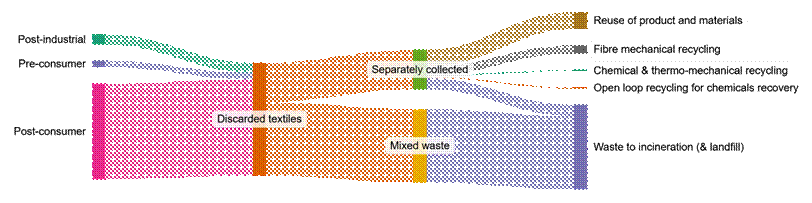
Figure 1: Textile waste flows in the early 2020’s as estimated through literature analysis.
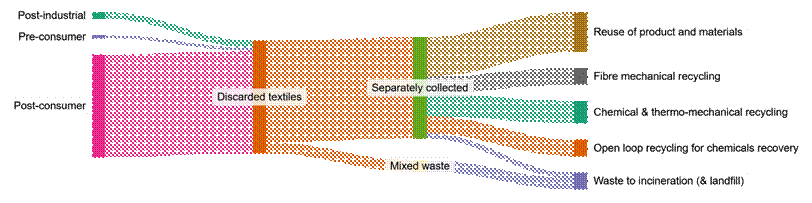
Figure 2: The potential textile waste flows with 80% waste reduction.
* For this work, analysis of seven different textile waste flow reports was conducted to estimate the current, early 2020’s textile waste flows. The review included the following reports:
- Publications Office of the European Union (2023) Techno-scientific assessment of the management options for used and waste textiles in the European Union. Available: https://publications.jrc.ec.europa.eu/repository/handle/JRC134586
- Fashion for Good (2022) Sorting for Circularity Europe. Available: https://www.fashionforgood.com/case-study/sorting-for-circularity-europe-an-evaluation-and-commercial-assessment-of-textile-waste-across-europe/
- McKinsey (2022) Scaling textile recycling in Europe—turning waste into value. Available: https://www.mckinsey.com/industries/retail/our-insights/scaling-textile-recycling-in-europe-turning-waste-into-value#/
- EEA (2024) Textile waste management in Europe’s circular economy. Available: https://www.eionet.europa.eu/etcs/etc-ce/products/etc-ce-report-2024-5-textile-waste-management-in-europes-circular-economy
- EEA (2024) Volumes and destruction of returned and unsold textiles in Europe’s circular economy. Available: https://www.eionet.europa.eu/etcs/etc-ce/products/etc-ce-report-2024-4-volumes-and-destruction-of-returned-and-unsold-textiles-in-europes-circular-economy
- EC Directorate-General for Internal Market, Industry, Entrepreneurship and SMEs (2021) Study on the technical, regulatory, economic and environmental effectiveness of textile fibres recycling. Available: https://data.europa.eu/doi/10.2873/828412
- Refashion (2023) Characterisation study of the incoming and outgoing streams from sorting facilities. Available: https://pro.refashion.fr/en/reports-and-studies
Contact us for more details:
Ella Kärkkäinen ella.karkkainen@vtt.fi
Julia Vuorinen julia.vuorinen@vtt.fi
Pirjo Heikkilä pirjo.heikkila@vtt.fi
Laua Wiman laua.wiman@vtt.fi