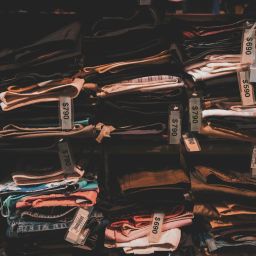

(Banner figure credits: Textile ETP)
What drives circular clothing choices?
Written by: Ella Kärkkäinen and Pirjo Heikkilä, VTT Technical Research Centre of Finland
Europe’s textile sector is under growing pressure to move from a linear “take-make-waste” model to a circular one, and that shift depends as much on people’s everyday buying habits as it does on new recycling technologies. The summer of 2026 has seen one of the significant shifts towards circularity in the textile sector in the EU; as of July 19th, large fashion brands are not to destroy unsold goods unless they are either unsafe, damaged, counterfeit, infringe on intellectual property rights or they are rejected by charities and donation schemes. The implementation of these rules means that all produced clothing, footwear and accessories will now circulate longer.
Even more fundamental legislation is expected soon to support the transition: on top of the destruction ban, the Ecodesign for Sustainable Products Regulation (ESPR) for textiles brings out requirements for durability and repairability as well as the tool for improving traceability of the textiles, the digital product passport (DPP). Simultaneously, the Textile Labelling Regulation is being revised, expected (and hoped-for) to result in clearer communication regarding the production and the materials, as well as providing feasibility in integrating novel textile material information into the care labels. Another policy mechanism, the Extended Producer Responsibility (EPR), will establish the post-consumer textile waste operations in Europe.
While these changes would be welcome for a more circular Europe, the vigorous setting up of new rules and regulations may result in fears and suspicions in some. For companies, where much of the pressure is set, fear of unprofitability may come into the picture. Suspicions regarding the increasing private imports of fast and ultra-fast fashion, and the rules or the lack of rules for the producers outside of Europe may awaken frustration and injustice for both commercial operators and consumers. The consumers’ role in the textile value chains has long been obvious, but as consumers are growing more conscious, and companies must consider circularity, the engagement of consumers becomes increasingly important.
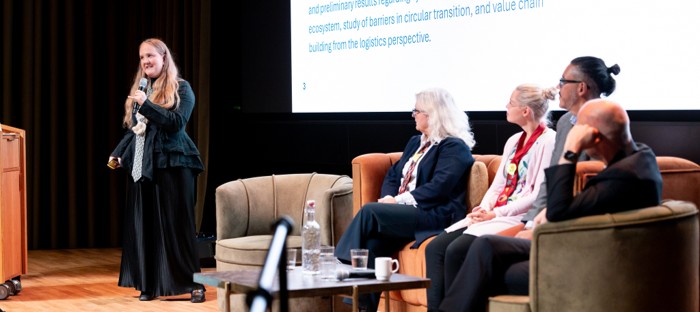
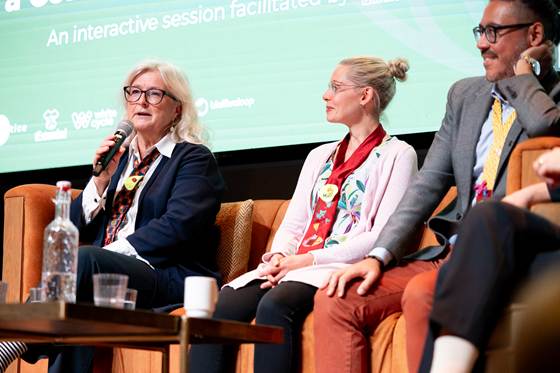
As a part of tExtended targets of enabling a systemic change in the textile ecosystem, we are interested in learning about the consumers. In this blog text, we go through some of the highlights of our workshop at the Third ECOSYSTEX conference 2025 in Gothenburg, where we asked our audience about their textile consumption behaviour.
Recycling and reuse outcomes start with consumer choices
To obtain high-quality recycled outputs, the input for recycling must be of good quality. “Good quality” eventually means different things for everyone, but for the fibre mechanical recycling it may mean that textiles are not mouldy; for chemical recycling it may mean that textiles have high contents of the targeted material; and for thermo-mechanical recycling (via melting) it could mean the absence of disruptors, such as metal zippers and buttons.
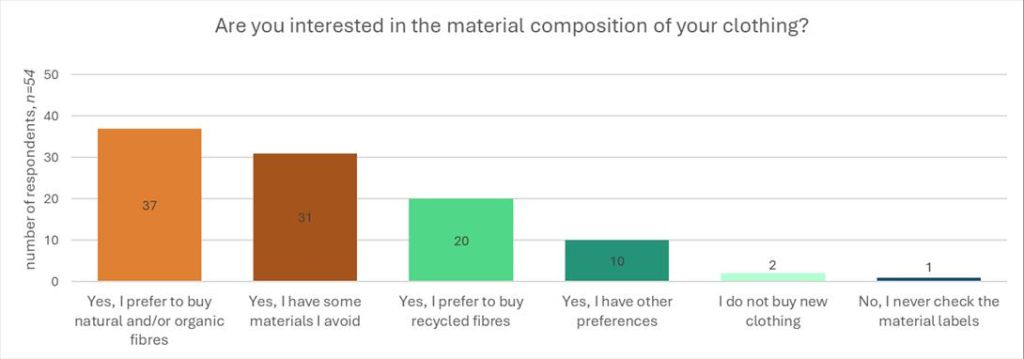
The group of textile and other experts attending our workshop in ECOSYSTEX 2025 conference was asked whether they consider material composition when buying clothing: more than two thirds said they prefer natural materials, more than half said they actively avoid some materials, and more than one third said they prefer recycled fibres. Some reported “other preferences,” and only a few said they do not buy new clothing, while just one person revealed they never check material labels.
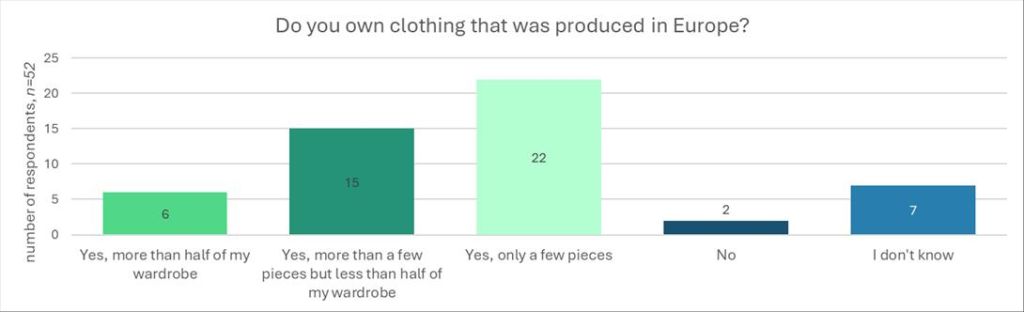
While not that critical for recycling, some respondents may also associate “good quality” with European production. When asked whether they own clothing produced in Europe, the majority (> 80%) of the group said “yes”. Here, it’s worth flagging a limitation: what “produced in Europe” means was not defined. Since consumers’ knowledge is often limited to what’s stated on the material label, this is likely the basis on which our group answered, meaning the results are indicative rather than exact. When asked about the reasons to buy European-produced textiles, three out of four said they preferred to “support European local production”. A little bit over a third of the group also a considered European production sustainable, European products safe, and the long freight distances from outside Europe unsustainable.
To operate recycling and reuse at a feasible, viable scale, a guaranteed supply of materials can be considered mandatory, depending on the operator. tExtended and other European research projects aim to find systemic and large-scale solutions for post-consumer textile waste, ultimately avoiding the gap between existing high-TRL production and new requirements. At the same time, textile production is widely absent in Europe, and for the sake of European ecosystems, it is interesting to estimate if a European production could be feasible, or if there is demand for it.
How consumers decide: quality, price, and avoiding ultra-fast fashion
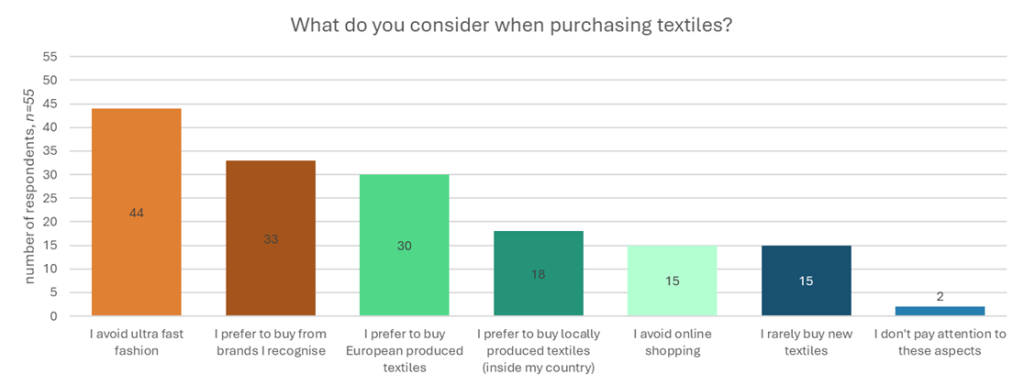
When we asked what influences people’s purchasing decisions, “avoiding ultra-fast fashion” was the most popular choice (80%). Other popular answers were “buying from brands I recognise” (60%) and “preference to buy European-produced textiles” (55%).
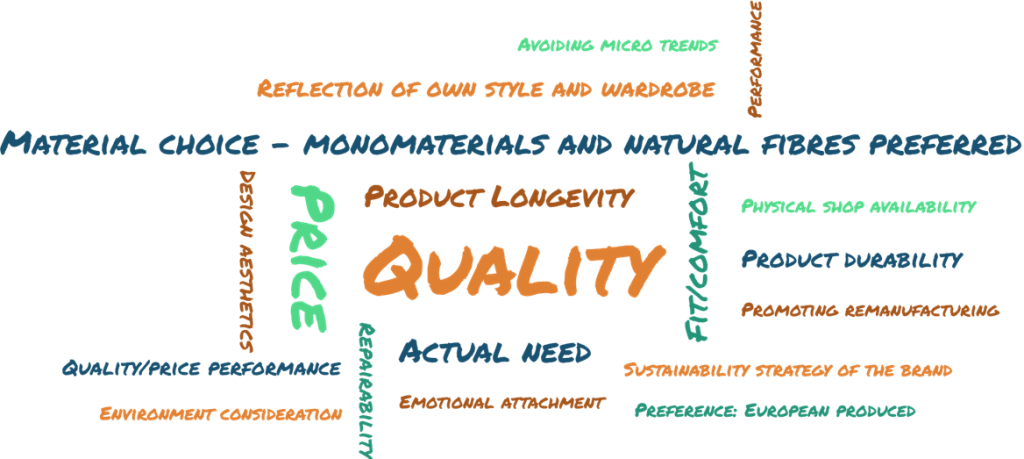
We also gave the group a possibility to elaborate consumer patterns and criteria in their own words. Quality was mentioned by half of the respondents, making it the aspect steering the purchase decision the most. Other closely related aspects such as product longevity, product durability and quality/price performance were mentioned several times as well. The second most important factor was price, mentioned by a third of all the respondents. Given the ECOSYSTEX conference context, this audience was likely more sustainability-aware than the general population; accordingly, actual need (whether the respondent really needs to buy the item) and material choice (including preferences for monomaterials and natural fibres)were both noted in multiple answers. In addition, multiple respondents valued a well-fitting, comfortable garment and appreciated when a garment complements their existing wardrobe or style.
To understand which markets would offer value to companies, we wanted to understand the consumer purchases – what is that consumers buy? And what purchases could they live without? When asked how our group could reduce their own textile consumption, they mentioned event-wear, festive wear and smart wear purchases could most easily be avoided, as they can be rented. Another reason for avoiding those products is the associated cost with few wears, as they don’t often fit everyday occasions. Many also mentioned the purchases of regular products, such as t-shirts, bra and jeans could be reduced, which could be interpreted as general desire to consume less. Seasonal and trendy clothing were also mentioned, partly attributing to the consciousness, and partly to the style choices: people may not feel the trendy, mainstream style clothing corresponds to their individual style.
The “conscious consumer” gap: awareness, motivation, and mixed behaviours
Consumer attitudes and behaviour are a crucial aspect in textile circularity. Challenges with communicating the true sustainability of practices to the consumers, and in turn their full understanding of the concept, as well as consumer unawareness of true costs of textiles, and perception of recycled products must be fixed before consumers can be fully engaged into the themes of textile circularity.
Consumer unawareness can result in lack of motivation to change for the companies. When asked “Do you consider yourself as a conscious consumer?”, a third of the audience said “yes” and almost half said “more than half of the time”. A handful of people said “less than half of the time” while no one claimed “no”. To understand the consumption habits of these conscious consumers, we also chained some questions: the figure below shows how the same people answered to three different questions. Most of the conscious consumers said they buy a mix of new and second hand clothing. At the same time, the option of only buying new clothing was more popular than only second-hand shopping. Continuing to the purchasing numbers, approximately one third said they bought less than 10 pieces of clothing, and another third said they bought something between 10 and 30 pieces in 2025. The answers to the last question are spread between all types of conscious consumption. Because of this, no clear conclusions can be drawn about whether buying second hand or new clothing, or the number of items purchased, is considered more conscious. Perhaps the only clear conclusion is the versatility of consumer behaviour.
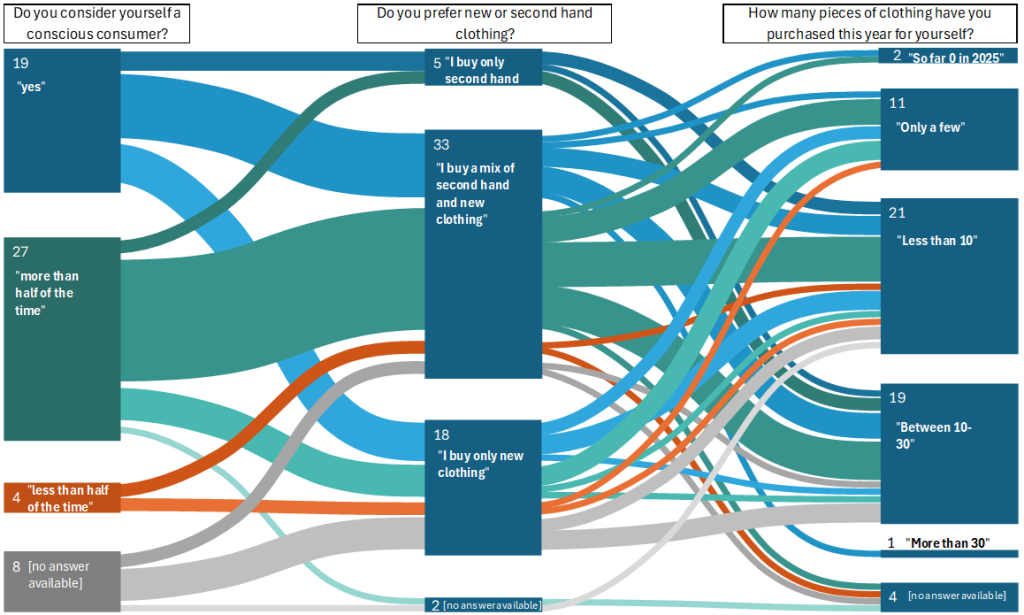
There is a fair amount of discussion about whether second-hand clothing can always be deemed the “sustainable choice”. In practice, the impact depends on factors such as how much it extends the active use of a garment, whether it replaces a new purchase, and the additional transport and cleaning involved. Still, the results highlight a key point for circularity: many consumers are open to second hand, or mixing second hand with new, but they do not see it as a complete substitute for buying new. This may also reflect how respondents interpreted the purchase question (e.g., whether they considered all wardrobe items, from socks to safety garments, or assumed the question only refers to the types of garments typically found in second-hand shops).
Overall, the workshop responses reinforce that consumers balance sustainability intentions with everyday realities. Quality and price still steer purchasing decisions, but so do actual need, material choice, longevity, comfort/fit and style factors that also influence whether a garment will be worn for long enough to matter from a circularity perspective. For circular textiles to scale, sustainable options must compete on these basics while also being easy to identify and trust.
Key takeaways
The engagement of consumers is becoming increasingly important, as what we buy determines what can be recycled. In this audience, many people said they actively check (or avoid) certain materials, and a notable share also values European-made items, often linking origin with sustainability, safety, and supporting local production. People’s personal values show in their consumption behaviour, even if quality and price still win in purchasing decisions. The responses also hinted at a shift: avoiding ultra-fast fashion, sticking with brands people trust, and sometimes favouring European production. Beyond that, the group mentioned very practical filters: only buying what they need, choosing comfortable and well-fitting pieces, and picking items that work with their existing style and wardrobe. One real barrier may come from the consumer attitudes, but another one is that even “conscious consumers” are inconsistent, and it is difficult to define the actions of a truly conscious consumer. Beyond this workshop, we could attribute this challenge to the current textile industry and its set of blockers: unclear sustainability claims, limited understanding and communication of true costs, and low trust in what “sustainable” means. If circular textiles are going to scale, the industry will need to make the sustainable choice easier to understand.
| How we conducted the study As part of the tExtended project, we ran a workshop with consortium partners VTT, RISE, TEKO and CARR to explore which changes in consumption and production, along with supporting processes in collection and sorting logistics, and legislation, may help the textile sector to achieve extended circularity. The workshop reached 89 participants, with up to 55 active respondents depending on the question (reported per question in Figures). Participants first answered as consumers and then reflected as experts; this re-cap focuses on the consumer perspective. The reported questions in this blog text: Are you interested in the material composition of your clothing? (multiple selection, n=54)Do you own clothing that was produced in Europe? (single selection, n=52)What do you consider when purchasing textiles? (multiple selection, n=55)Are there other factors that play a role when making a decision to buy? (open question, n=45, 59 responses)Which products would you give up first? (open question, n=36, 36 responses)Do you consider yourself a conscious consumer? (single selection, n=48)Do you prefer new or second hand clothing? (single selection, n=54)How many pieces of clothing have you purchased this year for yourself? (single selection, n=53) We had the wonderful opportunity to host a workshop at the Third ECOSYSTEX Conference in September 2025, where we gained valuable insights from Europe’s top textile experts and initiatives. ECOSYSTEX, the European Community of Practice for a Sustainable Textile Ecosystem, a network of over 90 EU-funded projects is supported by the European Commission’s HORIZON Europe programme and the Circular-Biobased Europe Joint Undertaking. Their Fourth ECOSYSTEX conference will take place in Antwerp, Belgium in September. https://www.ecosystex.eu/events/ecosystex-conference-2026 |