

Work clothing from post-consumer waste
In tExtended, we aim to create a sustainable textile ecosystem by optimizing textile flows and reducing waste through advanced recycling technologies.
Among the companies that worked on this goal, PurFi, a textile recycler focused on fibre rejuvenation technology, has been involved in several processes within the demonstrators for tExtended, in strong collaboration with other partners both inside and outside the project. Within tExtended, PurFi has worked with De Kringloopwinkel (and Valvan, outside of the partnership) in developing the soft mechanical recycling and has been involved in textile manufacturing with Utexbel and J. F. Almeida, for different activities.
Outside of tExtended, PurFi is realizing t-shirts and polos in collaboration with Concordia, a leading manufacturer of sustainable technical textiles, with whom they are also focusing on the possibilities of working on weaving filament yarns.
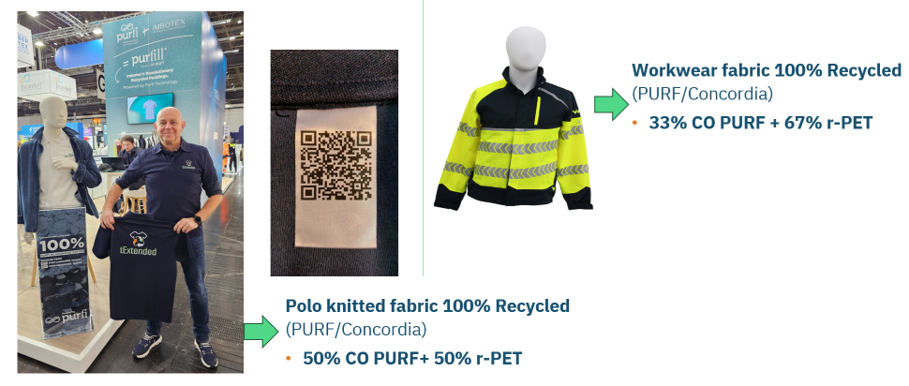
More specifically, in the collaboration with Concordia for the demonstration activities, PurFi had processed post-consumer textile of woven or knitted fabrics used as feedstock using their own technology (therefore by using soft fibre mechanical recycling), to unravel the textile waste into yarns and via reverse spinning into fibres. These fibres have then been blended in a mix of 33% cotton from Purfi with 67% r-PET to produce a woven fabric, which has then been dyed and finished with a fluorocarbon free water-repellent treatment in collaboration with Concordia. Finally, the fabric has been used by Concordia customers to make workwear garments.
Similarly, white t-shirts sourced by De Kringloopwinkel as waste post-consumer textile were used as feedstock and processed using the soft fibre mechanical recycling process through PurFi technology to unravel the textile waste into yarns and via reverse spinning into fibres. These fibres were blended 50% cotton from Purfi with 50% recycled PET to create a knitted fabric, which was then dyed, and finished in collaboration with Concordia. Quick response (QR) codes were printed on the garments for traceability using the digital product passport (DPP).
Finally, the knitted fabric was then used to manufacture polo T-shirts with the association of external partners from Portugal.