

Skip to main content Scroll Top
19th Ave New York, NY 95822, USA

TEXTILE ECOSYSTEM IN EUROPE

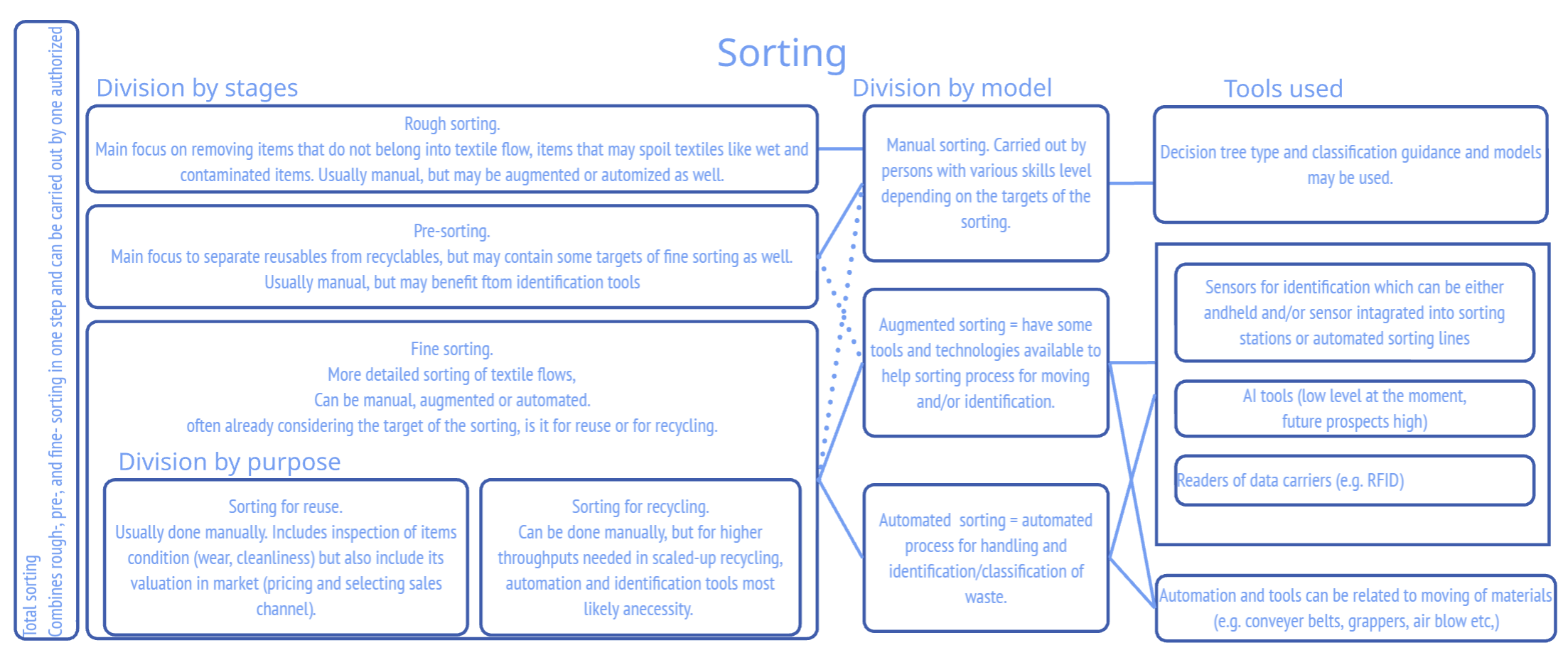
Collecting & Sorting

The collection and sorting of used textiles form a critical link between the use phase and subsequent circular pathways in circular textile system. Effective collection systems ensure that discarded textiles are captured separately from mixed waste, while sorting processes identify products suitable for reuse and separate materials according to their condition, composition, and potential next use. High-quality collection and sorting are essential for directing textiles to the most appropriate circular value-retention pathways, maximizing reuse and enabling efficient recycling.

Collection

Non-reusable textile collection
  • Mandatory separate collection since 2025
  • Mainly operated by collection points; containers and recycling centers (bring system)
  • Sometimes separately collected, sometimes in the same stream with reusable textiles
  • Dry and clean textiles accepted, wet or mouldy are not
  • Some municipalities may accept hygiene-sensitive items, others not
  • Municipalities may have a contract with organisations (collection partnerships)
  • Sorting is mainly done on a incineration, export, or recycling basis
  • NGOs and charities might collect non-reusables in case they have a one-stream collection bins
  • Sorting for reuse and recycling, or eventually for disposal
  • Brands may collect non-reusable and non-resellable textiles
  • Brands steer their own textile flows and the difference in definitions can vary
  • Non-reusable textiles collected by brands is sorted into incineration, export, or to recycling companies (collection partnerships)
Actors Municipalities NGOs, charities Brands Citizens
Reusable textile collection
  • Municipalities may organise collection and sorting of reusable textiles, and offer it to NGOs (collection partnerships)
  • Less commonly, municipalities that collect reusable textiles in the same stream as non-reusables can sell the reusable textiles in municipal second-hand shops
  • Mainly operated by collection in containers (bring system) and in second hand stores (drop-off systems)
  • NGOs and charities might collect non-reusables in case they have a one-stream collection bins
  • Usually, if municipalities collect the non-reusable textiles separately, NGOs and charities collect rewearables (collection partnerships)
  • Sometimes separately collected, sometimes in 1-stream with non-reusable textiles → more sorting required
  • Detailed sorting for reuse and resell, considering e.g. brand, value, style, season
  • Sorting for export
  • Mainly operated by In-store take-back systems; containers or at the checkout (drop-off system)
  • Other available systems include mail-back or collection points (bring system) at non-retail locations
  • Companies may also partner with NGOs who organise the collection (collection partnerships)
  • Deposit-returns and systems linked to EPR are emerging
  • Incentive-based systems relying on discount vouchers or store credits can be used
  • Some brands collect all brands and conditions, some limit this aspect
  • Brand-specific take-back enables product traceability
  • Sorting is done on a reuse/resell, recycling, export, and dispose basis
  • Repurposing
  • Peer-to-peer resale platforms, with direct C2C links (non-formal collection or user-driven exchange)
  • Clothing swapping in events or with family and friends
  • Other resale platforms, where a business enables C2C links, operate by e.g., send-in and home-pick-up systems
Other responsibilities/ core activities
(for textile circularity)
  • Design collection systems
  • Adapt systems according to the geographic area
  • Guide disposal practices
  • Maintain quality of textiles
  • Management and maintenance of collection infrastructure and convenience for citizens
  • Steer the definition of “reusable”
  • Export of textile flows
  • Customer engagement
  • Brand control
  • Steer the definition of “reusable”
  • Increasing producer responsibility
  • Export of textile flows
  • Rewearing, extension of lifecycle
  • Correct disposal

The Role of Logistics in Textile Circularity

In a circular textile chain, value chain building from logistics can mean that:

  • Transports are coordinated to reduce emissions.
  • Logistics are integrated with sorting and classification systems.
  • Reuse and material recycling are enabled through efficient return flows.
  • The end user receives information about the origin of products via traceability solutions (DPP).

The three most important terms in the future of circular/sustainable logistics can be described as follows:

1. Circularity flows

Not just flow from A to B – but flow that goes in loops.

Logistics becomes the key to collecting, sorting, reusing, repairing and recycling materials.

This is about building systems for return logistics, reverse logistics and integrating secondary flows (waste → resource) in an efficient way.

2. Traceability

Digital infrastructure that allows materials and products to be tracked throughout their entire life cycle. It is the basis for:

  • Transparency towards customers (origin, climate footprint, conditions).
  • Efficient use of resources (knowing what is there, where it is, in what condition).
  • Enabling new business models such as “product as a service” or material passports.

3. Resource efficiency

Instead of just cost/service level, optimization of energy, time, capacity and materials becomes central. This is where coordination, shared logistics solutions and climate-optimized transport come in.

Resource efficiency is measured not only in money but also in carbon dioxide, energy and utilization rate.

Optimization of logistics in circular system

Minimizing:

– Transportation cost

– CO2 emissions

Maximizing:

– Fill rate

– Material value

– Traceability (DPP)

Distance is critical – but rarely directly measured.

  • Proximity to the collection point is one of the most important factors for both the quantity and quality of collected material
  • System design that reduces distance increases participation and reduces the need for transportation
  • This means that research often optimizes for short distances, rather than first measuring actual trips.

Circular logistics/backhauling

Using return transports (that would otherwise be empty) to transport materials, for example:

  • Truck delivers new clothes → drives back with textile waste
  • E-commerce returns → combined load with recycling

What to analyze:

  • Where are existing flows?
  • Where is empty capacity?
  • Matching: Geography / Time / Volume, e.g. Retail → Distribution Center → sorting
  • Cost savings / CO2 reduction

Tools used for identification

Method / Tool Suitable For Pros Cons
Visible light -based methods
(e.g. RGB cameras, VIS HSI…)
Color classification, Visible disruptor identification (e.g. hard parts, prints, stains…) Affordable, existing sensors; can be used in sorting stations or automated lines; Algorithms needed for deeper analytics;
NIR-based methods
(e.g. spectroscopy, HSI)
Material identification including blend percentage estimation Relatively affordable, existing sensors; softwares also available; quick identification Surface method, errors in layered and other complex textiles;
Other spectroscopical methods Identification of chemicals and additives identification (FTIR & Raman spectroscopy), heavy elements (XRF) More in-depth chemical information can be probed Expensive, difficult to bring to on-line sorting.
Readers and data carriers like RFID Carrying to material composition and chemical and additive information Can contain very detailed information about original composition of material of individual products Require readers; information is lost if data carrier is lost

Risk management in sorting

Risks related to materials used (Reach compliance) Risks related to contaminants
New products should no more contain restricted chemicals. In circular system old products may contain chemical banned now and in future especially in textile finishes (PFAS in repellence and benzotriazole in UV absorber treatments) or dyes (heavy metals and azo dyes) Especilly workclothing an technical textile may be contaminated for a wide range of hararzous substances, while textiles in households are more prone to have biological contaminations (mould, insects, feaces).