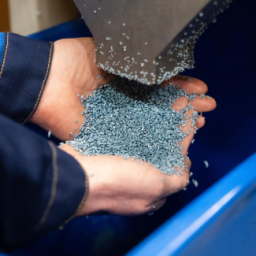


Textile materials with 40% post-consumer fibres
The tExtended project aims to create a sustainable textile ecosystem by optimizing textile flows and reducing waste through advanced recycling technologies. To reach this, we are working with textile companies that are focused on different textile processes; one of these is J. F. Almeida, a benchmark company in the home textiles sector and a fully vertical textile company available for the most diverse tests and trials.
Specifically, in the demonstrator activities, they have been focused on spinning, as they are producing yarns in a blend with 40% post-consumer recycled cotton fibres received from Purfi. J. F. Almeida has then produced two qualities of yarn with the same composition, one to be used in the ring and the second in the weft. Lastly, design and weaving structure has been defined for the production of bath towels with recycled yarn in the ring and weft.
During the process, J. F. Almeida has collected physical data from the raw material used that will support their work to optimize the processes so far implemented. They also have collected sufficient data for future tests, depending on the item to be produced.
In the framework of the demonstration activities, J. F. Almeida utilized a 500 kg blend consisting of 50% virgin cotton and 50% recycled cotton fibres obtained from Purfi to produce yarn through open-end spinning. The most interesting result obtained is linked to the level of performance of the two yarns: the recycled yarn achieved approximately 8 reel kilometres (rkm) tensile strength, compared to 9 rkm for yarns produced using 100% virgin cotton. This indicates comparable performance, as the recycled yarn exhibits tensile properties similar to the yarn produced using 100% virgin cotton fibres. Nevertheless, the measured values remain within the acceptable minimum range to ensure reliable weaving performance.
Finally, the produced yarn was employed to manufacture terry towels featuring the tExtended logo using a Jacquard weaving machine.
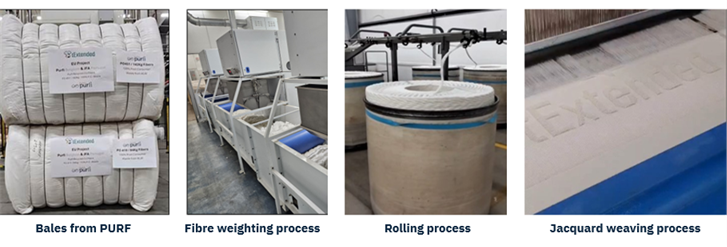
The recycled fibre presents itself with a homogeneous shade. In the next step, dyeing, J. F. Almeida will have the possibility to dye the fibres with light colours, obtaining good colour uniformity of the textile material.